When Glean Needs Snowflake: Why Enterprise AI Still Depends on Analytics Platforms
At Alchemy, we meet with customers at all stages of Data and AI maturity. We often get customers who are looking to get more immediate value out of investing in AI and want to know how much of an investment they need to make into Data Platforms like Snowflake. It all comes down to the business use case.
Enterprise AI platforms like Glean are changing how employees access information. In a matter of weeks, organizations can deploy a unified AI assistant that surfaces documents, chats, tickets, and internal knowledge across dozens of systems.
This leads many organizations to believe they have solved the “data problem.”
In reality, they have solved the knowledge discovery problem, not the analytical problem.
The distinction matters. AI platforms that operate over enterprise content are extremely powerful, but they are not designed to perform large scale analytical queries over structured business data. That is where platforms like Snowflake come in.
Understanding how these two layers work together is key to building a modern AI architecture.
Two Different Timelines
One of the most noticeable differences between an AI knowledge platform and an analytical platform is how quickly they come online.
| Platform | Typical Time to Value | Purpose |
|---|---|---|
| Glean | 4–8 weeks | Enterprise search, knowledge discovery, AI copilots |
| Snowflake | 3–12 months | Data consolidation, analytics, BI, AI data foundation |
Glean deployments move quickly.
In Glean, you connect systems that wouldn’t ever be ingested into Snowflake:
- Google Drive or SharePoint
- Slack or Teams
- Jira and Confluence
- Internal documentation repositories
- (In addition to your major Enterprise Systems – CRMs, ERPs, etc.)
Within a few weeks, employees can begin asking questions like:
- Where is the sales playbook?
- What decisions were made in last week’s leadership meeting?
- Where is the onboarding documentation for new hires?
This dramatically improves productivity and removes friction from knowledge discovery.
Analytical platforms take longer because the problem is different.
Snowflake requires:
- ingesting data from operational systems
- modeling business entities
- building governance and access controls
- creating semantic layers and dashboards
The result is not document retrieval. The result is the ability to answer analytical questions about the business.
The Types of Questions Glean Cannot Answer Alone
Glean excels at retrieving existing knowledge. If the answer exists in a document, chat thread, wiki page, or ticket, Glean is extremely effective.
Where it needs additional support is with questions that require computation across large volumes of structured data.
These include questions that require:
- aggregation
- trend analysis
- joins across systems
- statistical analysis
- historical comparisons
Those questions require an analytical engine.
Example: Sales
Glean can answer:
Where is the sales playbook?
Where did we document the new pricing strategy?
Who worked on the last Acme proposal?
But it cannot answer questions like:
- Which products had the highest win rates last quarter?
- What is our pipeline conversion rate by region?
- Which accounts show declining product usage before churn?
Those answers require querying structured CRM and product telemetry data.
Example: Operations
Glean can answer:
Where is the standard operating procedure for maintenance?
Where did engineering document the last outage?
But it cannot answer:
- Which equipment fails most frequently?
- What maintenance patterns correlate with downtime?
- What signals indicate an upcoming failure?
These require aggregating operational data across time and assets.
Why AI Still Needs a Data Platform
Most enterprises are discovering that modern AI architectures require two distinct layers.
Knowledge Layer
This layer contains enterprise content.
Examples include:
- documents
- chats
- tickets
- wikis
- policies
- meeting transcripts
Platforms like Glean index and understand this information so employees can find answers quickly.
Analytical Layer
This layer contains structured business data.
Examples include:
- transactions
- operational events
- financial metrics
- product telemetry
- customer activity
Platforms like Snowflake allow organizations to query, aggregate, and analyze that data at scale.
Both layers are necessary.
A Simple Architecture
Below is a common pattern that organizations are beginning to adopt.
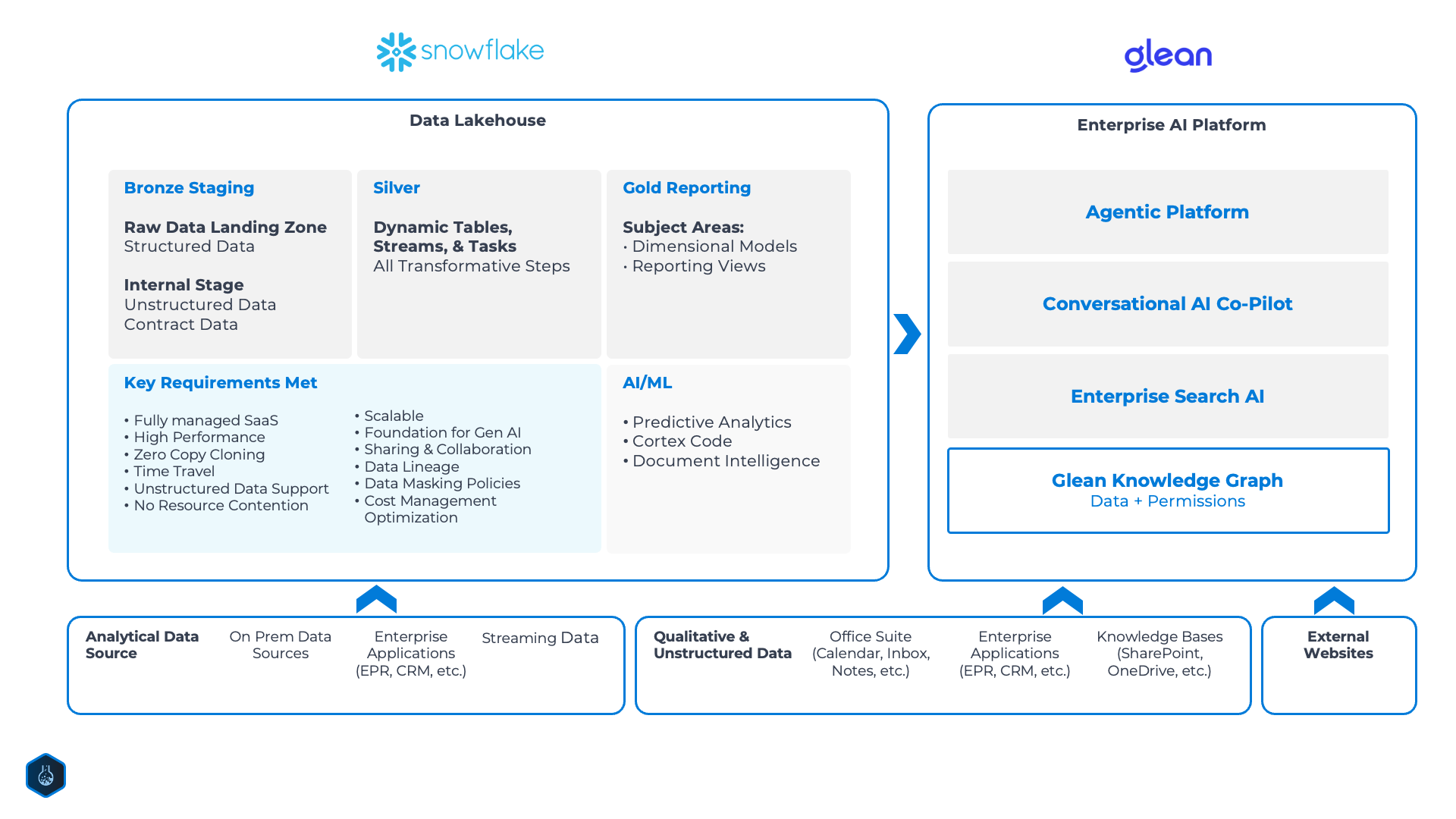
In this model:
- Glean acts as the conversational interface
- Snowflake acts as the analytical engine
Glean can surface context from enterprise knowledge while Snowflake provides the data needed to answer analytical questions.
The Strategic Takeaway
Deploying an enterprise AI assistant like Glean is one of the fastest ways to introduce AI into the workplace. Organizations can see immediate productivity gains because employees can finally search across the entire company’s knowledge.
However, the most valuable questions about the business rarely live in documents.
They live in data.
As organizations mature their AI strategy, many discover that the real power comes from pairing knowledge platforms with modern analytical platforms. When the two work together, employees can ask questions about both what the company knows and what the company’s data reveals. That is when enterprise AI begins to deliver real strategic insight.
To learn more about how to ensure your organization is ready to maximize the benefits of AI, sign up for a Data and Analytics or AI Strategy Mastermind.
Author
 Andy Quirin